
Structured support helping organisations manage commercial boiler, heating plant and statutory inspection responsibilities across occupied buildings.


Southern Maintenance Solutions supports property and facilities managers with planned compliance programmes across heating infrastructure and associated building systems.
Many organisations initially think about a commercial annual boiler service when reviewing their gas or heating compliance responsibilities.
While servicing is important, effective boiler and heating compliance typically involves a much wider programme of inspections, testing, documentation and ongoing compliance oversight across commercial heating systems and associated plant. Depending on the system and environment, this can include:
For occupied buildings and larger estates especially, maintaining organised inspection schedules and clear compliance records is just as important as the servicing itself, So …

Commercial heating systems are safety-critical assets within occupied buildings. Boiler & heating compliance play an important role in maintaining safe, comfortable and operational environments.
Organisations responsible for occupied buildings are expected to ensure commercial boiler plant and associated heating systems are appropriately maintained, inspected and operating safely in line with relevant regulations, manufacturer guidance and recognised maintenance standards.
Poorly managed or incomplete boiler & heating compliance inspection can lead to:
For schools, healthcare environments, retail buildings infact any occupied commercial buildings, maintaining servicing, inspections and compliance records is essential.
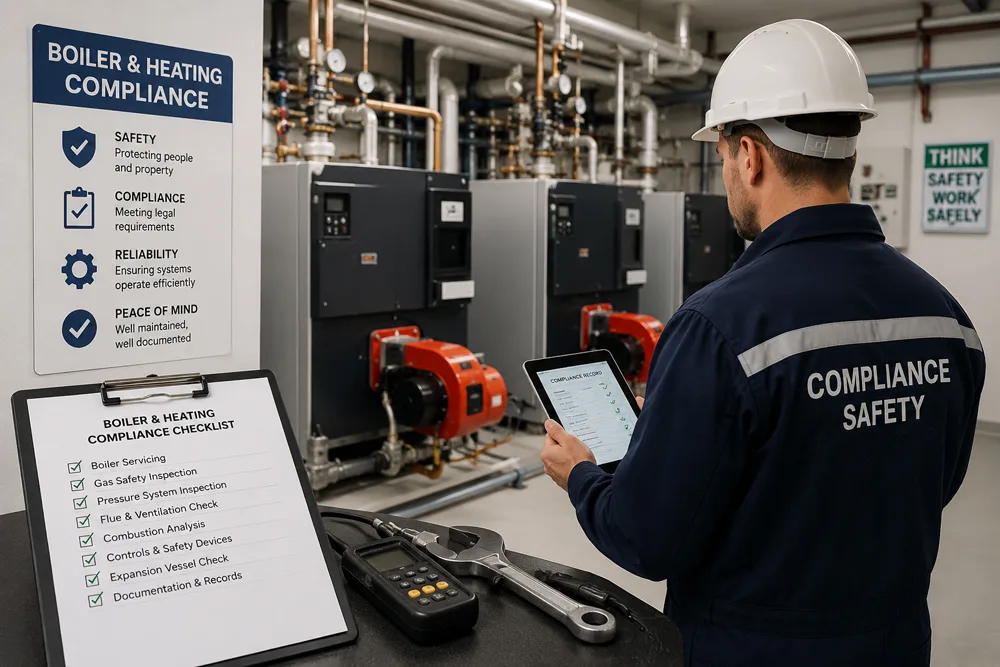
Inspection requirements and frequencies vary depending on system type, fuel source, pressure classification, occupancy and manufacturer guidance. Compliance programmes commonly include support across:
All boiler & heating compliance programmes include full compliance reporting and documentation with quoted remedial work coordination where required.
Requirements vary from one building to another, depending on equipment present. We can help your boiler & heating compliance with:
| Compliance Area | Relevant Guidance / Regulation | Typical Requirements |
|---|---|---|
| Commercial boiler servicing | Manufacturer guidance / SFG20 | Typically annual |
| Gas safety inspections | Gas Safety (Installation and Use) Regulations 1998 | Typically annual |
| Closed System Water Quality Testing | BG29 Closed System Water Treatment Guidance | Typically annual |
| Pressure vessel inspections | Pressure Systems Safety Regulations 2000 (PSSR) | As defined by Written Scheme |
| Combustion performance checks | Gas safety guidance / manufacturer guidance | During servicing |
| Flue & ventilation inspections | Gas Safety Regulations / manufacturer guidance | During servicing |
| Expansion vessel inspections | PSSR / manufacturer guidance | Planned inspection intervals |
| Heating controls & safety interlocks | SFG20 / manufacturer guidance | Planned maintenance intervals |
| Plantroom safety inspections | BG01 Guidance / H&S responsibilities | Planned inspection intervals |
Structured inspections and compliance testing help organisations achieve, demonstrate and maintain compliance across critical building systems, while supporting clear certification, reporting and compliance records.
Where issues, deterioration or non-compliant elements are identified, remedial works and system improvements help restore systems to a compliant, safe and operational standard. These will be quoted for your approval in order to achieve compliance.
Planned maintenance, scheduled inspections and ongoing compliance management help organisations maintain continued compliance across critical building systems and associated statutory responsibilities.:
Managing compliance across commercial buildings often involves more than simply arranging inspections. Maintaining compliant, safe and operational systems typically requires a structured approach that combines testing, remedial works and ongoing compliance management across the lifecycle of the building and its infrastructure.

Many compliance issues occur because inspections, servicing schedules and statutory checks become difficult to manage. Missed inspections and incomplete records can create operational, insurance and compliance risks — particularly across larger or multi-site environments.
Many organisations manage boiler and heating compliance reactively — arranging inspections only when servicing becomes overdue or issues occur. Don’t be one of these.
A Planned Compliance Programme provides you with a structured schedule of inspections, servicing and monitoring across heating systems and associated plant infrastructure. This helps organisations:
Structured compliance programmes help create a more manageable and inspection-ready framework across commercial heating infrastructure & supports duty holder responsibilities with confidence.
Many organisations manage compliance reactively — arranging inspections only when they fall due or when audits approach, often across multiple contractors, systems and service dates. Managing heating compliance with one company, fire systems with another, electrical inspections elsewhere and water hygiene separately quickly becomes costly, difficult to coordinate, be on top of, track and maintain across busy operational sites.
We will help your organisation simplify your compliance and planned maintenance around your buildings, systems and operational requirements. By coordinating inspections, testing, remedial works and ongoing maintenance across multiple services, we help simplify compliance management, reduce administrative burden and maintain clearer oversight across the year.
If you’re reviewing your boiler and heating compliance arrangements or planning upcoming inspections, we’re happy to help you assess your requirements and build a structured programme around your estate.
Southern Maintenance Solutions supports organisations with coordinated boiler and heating compliance support across commercial buildings & estates.
Keeping planned inspections organised and on track
Easy-to-follow records supporting compliance oversight
Helping reduce disruption across your estate
Quick remedial action when issues or failures are identified
Consistent support from engineers who know your site
Coordinated oversight across multiple buildings and locations
Commercial heating systems may fall under several regulations and guidance documents including the Gas Safety (Installation and Use) Regulations 1998, Pressure Systems Safety Regulations 2000 (PSSR), workplace health and safety responsibilities and planned maintenance guidance such as SFG20.
Compliance responsibilities vary depending on the plant type, operating temperature, pressure system classification and building use.
Missed inspections can increase operational, safety and compliance risks across occupied buildings.
Poorly managed servicing and inspection programmes may contribute to unsafe operation, unexpected plant failure, invalid manufacturer warranties, insurance complications and difficulty demonstrating due diligence following incidents or audits.Compliance responsibilities vary depending on the plant type, operating temperature, pressure system classification and building use.
Yes. Commercial gas installations must be managed in line with the Gas Safety (Installation and Use) Regulations 1998.
Commercial gas safety inspections are typically carried out annually and help verify the safe operation of gas appliances, pipework, ventilation systems and flues.
In some cases, yes.
Heating systems operating above certain pressure and temperature thresholds may fall under the Pressure Systems Safety Regulations 2000 (PSSR), requiring a Written Scheme of Examination and periodic inspection by a competent person.
Yes. Incomplete inspection records, overdue statutory checks or poorly documented compliance programmes can create difficulties when demonstrating appropriate oversight following incidents, insurer reviews or investigations.
Maintaining organised inspection schedules and compliance records helps organisations demonstrate that heating systems are being appropriately managed across occupied buildings.
SFG20 is the recognised industry standard for building maintenance specification used widely across facilities management and commercial estates.
It provides planned maintenance guidance helping organisations structure legally compliant maintenance programmes across building systems and infrastructure.
Many organisations use planned compliance programmes to coordinate inspections, servicing schedules, reporting and remedial works across multiple buildings or estates.
Structured oversight helps reduce the risk of missed inspections, incomplete records and inconsistent maintenance standards across sites.
Responsibility typically sits with the duty holder. This may include facilities managers, estates managers, landlords, employers or organisations responsible for maintaining safe occupied buildings.
Commercial boilers are commonly serviced annually, although inspection frequencies can vary depending on manufacturer guidance, system usage, risk profile and insurance requirements.
Relevant responsibilities may involve areas covered by the Gas Safety (Installation and Use) Regulations 1998, Pressure Systems Safety Regulations 2000 (PSSR), workplace health and safety responsibilities and planned maintenance guidance such as SFG20.
Programmes commonly include boiler servicing, gas safety inspections, combustion analysis, pressure system monitoring, plantroom inspections, controls testing and compliance reporting.
Yes. Planned compliance programmes can help organisations coordinate servicing schedules, inspection records and maintenance support across multiple buildings or estates.


One of our team will respond as soon as possible
