
Structured support helping organisations manage water hygiene, Legionella and statutory water safety responsibilities across occupied buildings


Southern Maintenance Solutions supports organisations with structured water hygiene and Legionella compliance programmes across commercial buildings and complex estates.
We help facilities managers, estates teams and duty holders maintain clearer oversight of water systems, monitoring schedules, compliance documentation and associated statutory responsibilities.
Many organisations initially think about Legionella testing when reviewing water hygiene responsibilities.
While water sampling can form part of a compliance programme, effective water hygiene and Legionella compliance typically involves a much wider programme of risk assessment, monitoring, inspections, documentation and ongoing compliance oversight across building water systems.
Depending on the building and system type, this can include:
For occupied buildings and larger estates especially, maintaining organised monitoring schedules and clear compliance records is just as important as the testing itself.

Water systems within commercial buildings must be appropriately managed to help reduce the risk of Legionella bacteria and maintain safe water hygiene standards across occupied environments.
Organisations responsible for commercial premises are expected to manage water systems in line with HSE Approved Code of Practice L8 (ACOP L8) alongside HSG274 guidance and wider health and safety responsibilities.
Whilst water seems innocuous and is very common in our lives, it needs close management in commercial settings as related health and safety issues can be hugely consequential. Poorly managed water hygiene and legionella compliance can contribute to increased safety and liability risk, such as:
For schools, healthcare environments, hospitality buildings and occupied commercial premises especially, maintaining clear oversight of water hygiene monitoring, inspections and compliance records is essential.
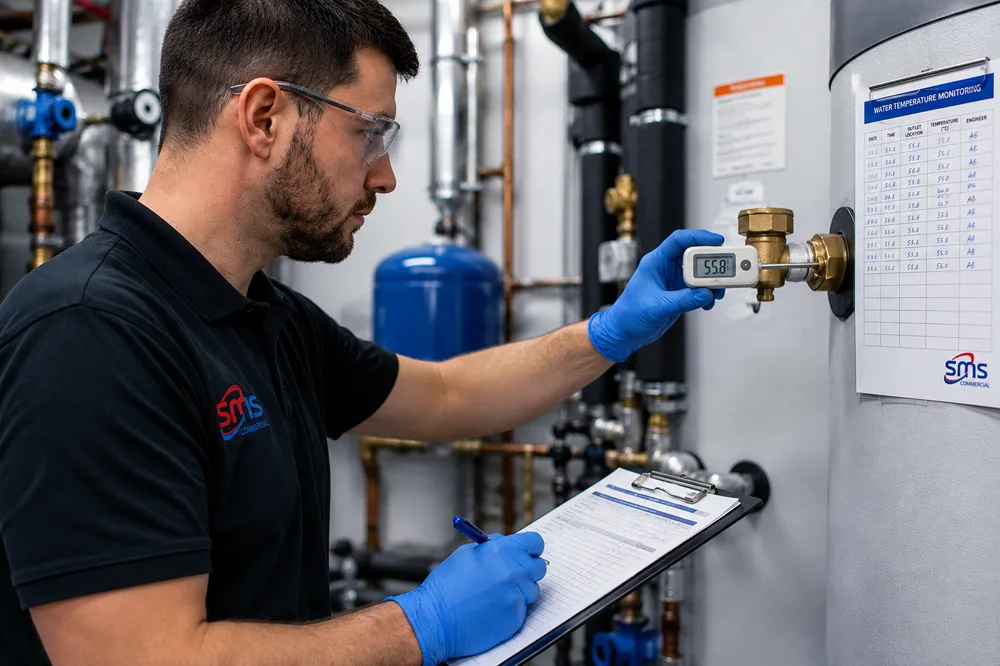
Inspection requirements and frequencies vary depending on system type, occupancy and manufacturer guidance. Compliance programmes commonly include support across:
All water hygiene and Legionella compliance programmes include full compliance reporting and documentation with quoted remedial work coordination where required.
Requirements vary from one building to another, depending on equipment present. We can help your water hygiene and Legionella compliance with:
| Compliance Area | Relevant Guidance / Regulation | Typical Requirement |
|---|---|---|
| Legionella risk assessments | HSE ACOP L8 / HSG274 | Assessments should be reviewed regularly and when systems or building use changes |
| Water temperature monitoring | HSG274 guidance | Sentinel outlets commonly monitored monthly |
| Hot water calorifier inspections | HSG274 guidance | Commonly inspected annually |
| Cold water storage tank inspections | HSG274 guidance | Commonly inspected annually |
| Shower cleaning & descaling | HSG274 guidance | Commonly completed quarterly |
| TMV servicing & inspections | NHS D08 / manufacturer guidance | Frequencies vary depending on risk environment |
| Water sampling | Risk assessment dependent | Sampling requirements vary by system risk |
| Closed system monitoring | BG29 guidance | Closed systems commonly monitored annually |
Structured inspections and compliance testing help organisations achieve, demonstrate and maintain compliance across critical building systems, while supporting clear certification, reporting and compliance records.
Where issues, deterioration or non-compliant elements are identified, remedial works and system improvements help restore systems to a compliant, safe and operational standard. These will be quoted for your approval in order to achieve compliance.
Planned maintenance, scheduled inspections and ongoing compliance management help organisations maintain continued compliance across critical building systems and associated statutory responsibilities.:
Managing compliance across commercial buildings often involves more than simply arranging inspections. Maintaining compliant, safe and operational systems typically requires a structured approach that combines testing, remedial works and ongoing compliance management across the lifecycle of the building and its infrastructure.

Many water hygiene compliance issues occur because monitoring schedules, inspection records and statutory checks become difficult to manage across busy estates and multiple buildings.
Missed monitoring, incomplete records or poorly managed water systems can increase health, operational and compliance risks while making it more difficult to demonstrate appropriate compliance oversight following audits or investigations.
Planned compliance programmes help organisations maintain clearer visibility across water systems, monitoring schedules and associated compliance responsibilities.
Structured compliance programmes help create a more manageable and inspection-ready framework across commercial water infrastructure & supports duty holder responsibilities with confidence.
Many organisations manage compliance reactively — arranging inspections only when they fall due or when audits approach, often across multiple contractors, systems and service dates. Managing heating compliance with one company, fire systems with another, electrical inspections elsewhere and water hygiene separately quickly becomes costly, difficult to coordinate, be on top of, track and maintain across busy operational sites.
We will help your organisation simplify your compliance and planned maintenance around your buildings, systems and operational requirements. By coordinating inspections, testing, remedial works and ongoing maintenance across multiple services, we help simplify compliance management, reduce administrative burden and maintain clearer oversight across the year.
We’re happy to review your current arrangements and help build a structured water hygiene and Legionella compliance programme around your buildings and operational requirements.
Southern Maintenance Solutions supports organisations with coordinated water hygiene and Legionella compliance support across commercial buildings and complex estates.
Keeping water safety inspections organised and on track
Easy-to-follow records supporting compliance oversight
Helping reduce disruption across your estate
Quick remedial action when issues or failures are identified
Consistent support from engineers who know your site
Coordinated oversight across multiple buildings and locations
Yes. Organisations responsible for commercial buildings have legal responsibilities under health and safety legislation to identify and manage risks associated with Legionella bacteria within water systems.
A Legionella risk assessment is a review of a building’s water systems used to identify potential conditions where Legionella bacteria could grow and spread.
The assessment helps determine what monitoring, control measures and ongoing compliance arrangements may be required.
Legionella risk assessments should be reviewed regularly and whenever there are significant changes to the water system, building use or occupancy levels.
No. Water sampling can form part of a wider compliance programme, but effective Legionella compliance also involves monitoring, inspections, temperature checks, flushing regimes, record keeping and ongoing system management.
Missed monitoring or incomplete records can increase health, operational and compliance risks while making it more difficult to demonstrate appropriate compliance oversight following audits, investigations or incidents.
Maintaining organised inspection schedules and compliance records helps organisations demonstrate that heating systems are being appropriately managed across occupied buildings.
Guidance commonly recommends stored hot water temperatures remain at 60°C or above, with cold water ideally stored below 20°C to help reduce conditions favourable to Legionella growth.
Responsibility typically sits with the duty holder. This may include facilities managers, employers, estates teams, landlords or organisations responsible for occupied commercial premises.
Sentinel outlets are the taps or outlets closest to and furthest from a water source. These outlets are commonly monitored as part of routine temperature checks within water hygiene programmes.
Poorly managed water hygiene programmes can increase the risk of Legionella bacteria developing within building water systems.
In occupied environments, this can create health, operational and compliance risks while making it more difficult for organisations to demonstrate appropriate control measures and compliance oversight.
Yes. Organisations responsible for commercial buildings are expected to manage Legionella risks appropriately under health and safety legislation and HSE guidance including ACOP L8.
Where water systems are poorly managed, organisations may face enforcement action, investigation or increased liability exposure following incidents or compliance failures.
Clear monitoring records, inspection documentation and risk assessment reports help organisations demonstrate that water hygiene responsibilities are being actively managed.
Accurate records can be important during audits, investigations, insurer reviews and ongoing facilities management oversight.
Where water systems are poorly managed, organisations may face enforcement action, investigation or increased liability exposure following incidents or compliance failures.
Yes. Reduced occupancy or low water usage can sometimes increase stagnation within water systems, potentially creating conditions more favourable for Legionella growth.
Buildings with changing occupancy patterns often require particularly careful water hygiene management and monitoring arrangements.
We support organisations managing water hygiene and Legionella compliance across many sectors, with each environment presenting different occupancy risks, water system requirements and compliance responsibilities. We help tailor support programmes accordingly.


One of our team will respond as soon as possible
